

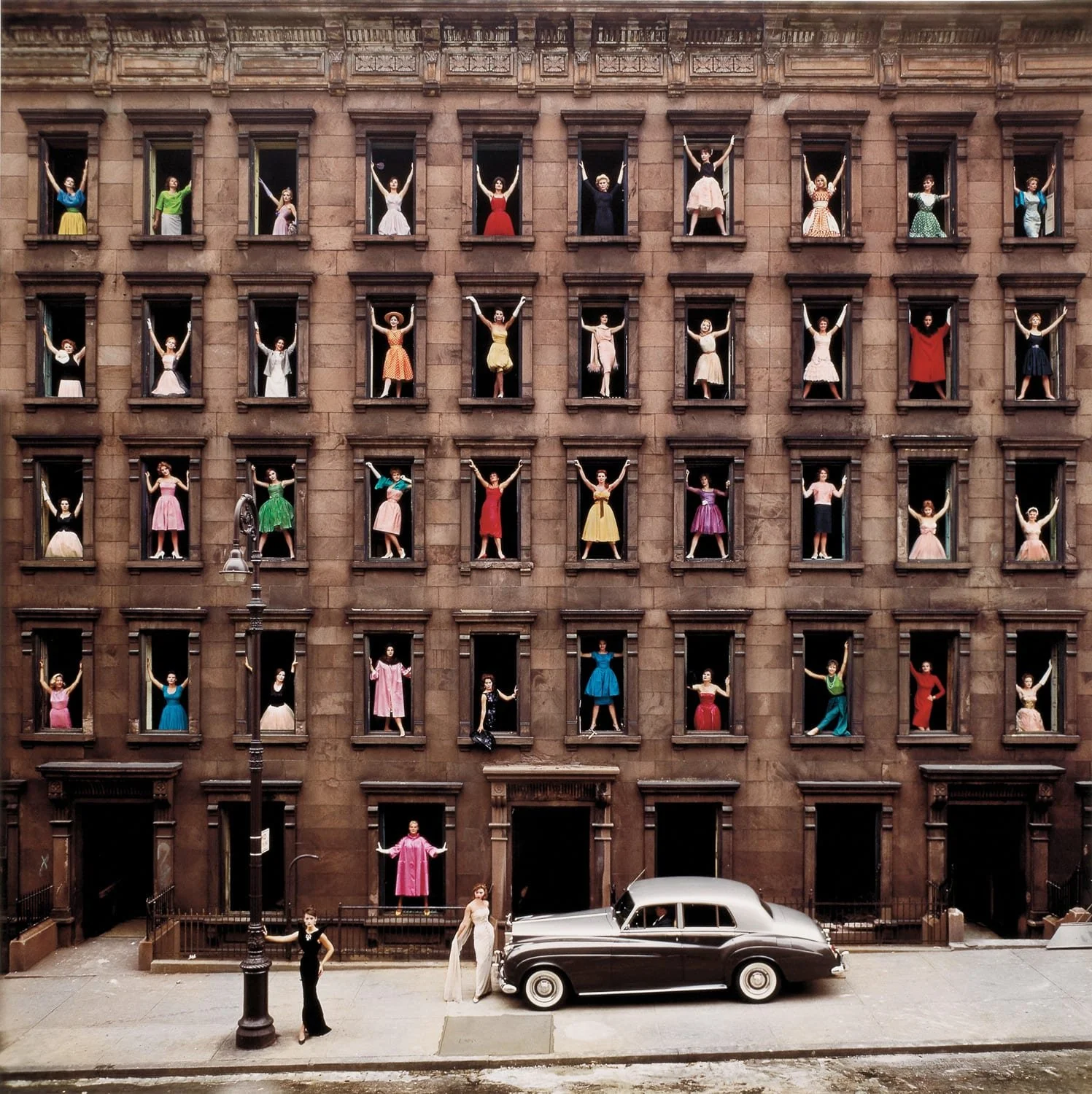
Title: Girls In The Windows, 1960
Artist: Ormond Gigli (American, New York 1925-2019 West Stockbridge)
Medium: Archival Pigment Print
Classification: Photograph
Description: “ ‘Girls in the Windows’, 1960 is an image not only about beauty, fashion and the ingenious orchestration of 43 women standing at the windows and on the sidewalk, some daringly climbing onto the window sills. It is also a slice of time in history, as it captures a row of three classic New York Brownstones, which were demolished the day after the shoot. Gigli, who lives across the street, wanted to immortalize the buildings and this envisioned the photograph. His meticulous planning and direction resulted in a dramatically compelling and memorable artwork.
The richness of the photograph stems from the ability to appreciate it in different ways: either as a whole, as a rhythmic composition of color and form, formed by the pattern of windows, human figures and colorful dresses; or the viewer is drawn to explore it various parts, each woman presenting a different point of interesting story (Gigli’s wife if on the second floor, far right and the demolition supervisor’s wife is on the third floor, third from left). It has since been the inspiration to many recreations by other image makers.”
Source: ormondgigli.com
Article: Segal, David. “Is This the World’s Highest-Grossing Photograph? “
Source: nytimes.com

Photograph by: Anna Puzatykh / Getty Images
Article: Bulano, Madeline. “Use Our Ultimate Spring-Cleaning Checklist to Give Your Home a Total Refresh: Consider this your room-by-room game plan for your annual deep clean.”
Source: Martha Stewart
Spring is right around the corner, which means so is your home's annual deep clean. Not only is spring cleaning a great way to reset (that's what the season is all about!), but the yearly chore also gets rid of any accumulated dust and dander before allergy season reaches full swing. Cleaning your home from top to bottom may never become effortless, but you can make the project more manageable with our comprehensive checklist from Martha's Homekeeping Handbook, complete with advice from cleaning experts.
Whether you prefer to proceed from the attic to the basement or start outdoors and wind your way inside, create a realistic schedule and focus on one task at a time. You'll need several days for more involved projects, such as mopping floors and organizing closets, but in due time, you'll check everything off your list—and have a sparkling clean home by the end of it.
Full Article: Use Our Ultimate Spring-Cleaning Checklist to Give Your Home a Total Refresh

Photograph by: Jessica Delaney
Article: Acampora Editorial. “Project Reveal: Cozy New England Colonial.”
Source: Acampora Interiors


Photograph by: Ashish Sahi
Article: Khan, Sarah. “The Iconic Palladio Expands in Jaipur, India.”
Source: The New York Times Style Magazine

Photograph by: Simon Watson
Article: Scheips, Charlie. “Decorator Elsie de Wolfe Took L.A. by Storm in the 1940s.”
Source: Architectural Digest

Photograph by: Mary Evans Picture Library/Imagno
Article: Scheips, Charlie. “Decorator Elsie de Wolfe Took L.A. by Storm in the 1940s.”
Source: Architectural Digest

Photograph by: Lesley Unruh
Article: Fischer, Page Porter. “Be Inspired By The Fresh Look Of This Historic Bronxville Charmer.”
Source: Luxe Interiors + Design

Photograph by: Alexander James
Article: Shaw, Ros Byam. “Polly Nicholson's flower-filled Georgian house in Wiltshire.”
Source: House & Garden

Title: Charles James Gowns, New York, 1948
Artist: Cecil Beaton (British, London 1904–1980 Broadchalke)
Date: June 1, 1948
Medium: C-Print
Classification: Photograph
Publication: Vogue/Condé Nast Archive
Description:
Nine models, including Marilyn Ambrose, Dorry Adkins, Carmen Dell'Orefice, Andrea Johnson, Lily Carlson, and Dorian Leigh, wearing Charles James gowns. Posed in French & Company's eighteenth century French paneled room.
Source: The Metropolitan Museum of Art

Title: Jardin Japonais
Printer: Zuber et Cie, Rixheim, France
Medium: Papier Peint Panoramique
Classification: Wallpaper
Credit: Courtesy of Zuber et Cie

Title: Chasse au Tigre
Printer: Zuber et Cie, Rixheim, France
Classification: Wallpaper
Credit: Courtesy of Zuber et Cie

Title: View of New York Bay from New Jersey
Series: Views of North America lengths 1–6 c. 2018 (first edition 1834)
Artist: Jean-Julien Deltil (1791–1863)
Printer: Zuber et Cie, Rixheim, France
Classification: Wallpaper
Description: 1,690 printing blocks, 223 colors, and 32 lengths
Credit: Courtesy of Zuber et Cie

Title: Scènes Japonaises
Printer: Zuber et Cie, Rixheim, France
Classification: Wallpaper
Credit: Courtesy of Zuber et Cie

Resicom Corp is deeply concerned about the Russian invasion of Ukraine and stand with all of the people who are suffering as a result of the violence.
We continue to monitor this tragic situation and join all those around the world who are calling for peace.
December 15, 2021

Photographed by Robert Fairer, Vogue, February 2009
For even the most seasoned host and hostess, the month of December doubles as the soirée Olympics. Holiday decoration ideas must be carefully thought of, table sets must be cohesive, dress codes must be communicated, and holiday treats must be flavored to perfection. Partaking in these practices is just part of what makes the season so festive.
While there are many gold standards and rules of hosting (such as being attentive to your seating charts and personally greeting each of your guests), how a host chooses to decorate isn’t as rigid. Some keep the holiday tradition alive with classic decor items of Baccarat Crystal and heirloom china that will forever remain in style. Others choose to have a little more fun with quirkier accessories and playful tablescapes. And some express their undying love for the holiday spirit through Christmas-themed dishware.
No matter if you have your sights on a grand party that rivals Truman Capote’s Black and White Ball or will opt for something a tad more intimate, the possibilities of creating the party that leaves attendees dazzled and non-attendees hoping for next year’s invite are endless.
Below, shop holiday decoration ideas that will guarantee your celebration is a memorable one.
By Greg Mania
January 28, 2021

Photograph by David Buffington / Getty
In the spirit of new beginnings, why not take the time to kick some of the unproductive habits you picked up last year? Now is the perfect moment to recharge, refocus, and reconsider the hours you spend looking on Zillow for a place that’s literally anywhere but the one you’ve been sitting in since March. Here are some tips on how to reclaim your life and your space (which, let’s be honest, you’re not leaving anytime soon).
1. Identify your triggers.
Triggers usually play a part in developing a destructive habit. Working to identify them is the first step in eventually breaking your Zillow addiction.
Start by taking note of the following:
At what time of day does your mind usually wander to what having a breakfast nook would be like?
Where are you when it dawns on you that you could probably afford a spacious full-floor apartment in Iowa City for the same amount you pay to rent a cramped studio apartment in Bed-Stuy with a heater that’s “just for display”?
What is your emotional state immediately before you are consumed by the temptation to throw all of your possessions into the sea and start life anew in a sleepy town known for its local artisanal mustard?
Is Slack just down?
2. Start small.
As with any other habit, you’ll want to ease into kicking Zillow—imagine transitioning from having a soda with every meal to simply not having a soda with dinner for a week. It’s not going to happen overnight! Instead of taking a 3-D tour of a three-thousand-square-foot breathtaking brick beauty that exudes both traditional, colonial charm and contemporary panache and features a calm stream running through the property, start by taking a 3-D tour of a three-thousand-square-foot breathtaking brick beauty that exudes both traditional, colonial charm and contemporary panache which does not feature a calm stream running through the property. Baby steps!
3. Don’t go through it alone.
Even just dealing with the urge to browse a photo gallery of a desirable three-bed, three-bath tucked away at the end of a winding, tree-lined drive, equipped with a Poggenpohl chef-quality kitchen and a master suite with a rainfall-jet shower, can be difficult. But guess what? You’re not alone. Look at how many people saved that listing!
4. Practice mindfulness.
By developing awareness of your thoughts, feelings, and actions, you’ll become more aware of your impulse to see what the sitch is like in Rockport, Maine. Have you ever been to Rockport? What made you decide on Rockport in the first place? Are you just closing your eyes and pointing at a map? Observe your routine behavior of constantly making unrealistic sacrifices: forsaking the dream of an ivy-enshrouded Victorian in a spellbinding New England town for the warm climate of Southern California (your asthma will thank you!); being O.K. with there not being a rolling library ladder in the sprawling two-story condo, because you’ll settle for the eight-foot kitchen island and deeded parking. Remember, you will probably never be able to afford your own home, anyway!
5. Leave yourself reminders.
Using sticky notes or other visual cues wherever your Zillow urge most often strikes is a great way to pause and rethink opening another browser tab, only to find that maybe a renovated town house just isn’t your vibe, even with a decrease in price. Sure, you were thinking about dipping your toe into the chalet pool, but why dismiss the town house completely—it does have a generous open-floor plan, and you’ve always wanted to double up on sofas to create a sumptuous conversation area! Also, have you seen what you can do with the right hide rug?!
6. Replace your Zillow habit with a different one.
Have you tried smoking?
Greg Mania is the author of the memoir “Born to Be Public.”
New York City is on track to enter Phase 2 on June 22. Other regions of the state are already in Phase 3. Here is our best attempt to explain what it all means.
Original article: https://nyti.ms/2Z3JDHt

In Phase 2, New York City residents will be able to get haircuts and dine at outdoor restaurants, among other changes. Credit: Juan Arredondo for The New York Times
By Michael Gold and Matt Stevens
June 19, 2020, 5:00 a.m. ET
After New York implemented blanket shutdown orders in March that closed stores, shuttered offices and curtailed business at restaurants and bars, state officials set up a gradual process to restart the state’s economy and ease restrictions.
Under the state’s plan, regions of New York that show they have been able to effectively keep the virus contained can reopen sectors of the economy in four phases.
All phases of the reopening require New Yorkers to adhere to social distancing guidelines, including wearing masks or face coverings in crowded public spaces, on public or private transportation or in for-hire vehicles.
Here is a look at each of the four phases, and what can open when:
Phase 1
The entire state has hit the health and safety benchmarks required to enter Phase 1, the start of the reopening process. New York City was the last region to enter the phase, on June 8.
The nonessential businesses that are allowed to resume in this stage include:
All construction sites, with safety equipment and temperature checks required
Manufacturers
Nonessential retail stores, for delivery, curbside and in-store pickup Wholesalers
Outdoor businesses like drive-in movies, landscaping and gardening
Some of these businesses had already been operating during the state’s shutdown orders. Some construction work was deemed essential and continued, and many manufacturers, particularly those that made protective gear and medical equipment, had been open.
Restaurants and bars have been allowed to offer takeout and delivery throughout the pandemic.
Phase 2
Almost every region of the state has also moved into Phase 2.
New York City, the region hardest hit by the pandemic, will be the last to move into the second stage on June 22, officials said.
In this phase, several indoor businesses were allowed to reopen, but with limits on capacity, strict cleaning requirements and mandatory social distancing.
The nonessential businesses that are allowed to reopen in this phase include:
Outdoor dining at restaurants
Hair salons and barber shops, with their waiting areas closed Offices
Real estate firms, inspections and in-person showings
In-store retail (Malls may not open, but individual stores can provide curbside pickup and anchor tenants can open for in-store shopping.)
Vehicle sales, leases and rentals
Retail rental, repair services and cleaning services
Commercial building management
Phase 3
Seven regions of Upstate and Central New York have been cleared to continue to Phase 3. Gatherings of up to 25 people (up from 10) are allowed in parts of the state that have entered this phase.
The additional nonessential businesses that are allowed to restart in this phase include:
Indoor dining at restaurants with up to 50 percent capacity and tables spaced at least six feet away from each other; seating in bar areas is permitted, but only if six feet of distance can be maintained between parties
Personal care services such as nail salons, massage parlors, spa services and tanning salons
Some “low-risk” youth sports can begin on July 6.
Phase 4
No region of New York has yet been cleared by state officials to enter Phase 4, the last stage of the reopening outlined by Gov. Andrew M. Cuomo.
In broad terms, officials have signaled that businesses that provide the arts, entertainment and recreation, as well as schools, will be allowed to open in this phase. But with no part of the state in it yet, officials have not been specific about what will be allowed.
Some of the businesses that have not been allowed to reopen during the first three phases of the process include:
Event venues for large gatherings
Gyms and fitness centers
Casinos
Movie theaters
Amusement parks, aquariums, zoos, arcades, bowling alleys and other entertainment centers
Other Helpful Things to Know
State officials have also made determinations about how and when various other specific activities can proceed. Among the highlights:
Veterinarians and dentists are allowed to open statewide.
Hospitals and group homes — but not nursing homes — can accept visitors at their discretion as long as proper health and safety measures are in place.
State parks, campgrounds and RV parks are open; marinas and boatyards are open for personal use; state beaches are open with certain restrictions.
Outdoor school graduations of up to 150 people with social distancing will be allowed beginning June 26.
Summer day camps may open June 29.

WE ARE COMMITTED TO OPERATING IN ANY ENVIRONMENT WITH THE HIGHEST SAFETY STANDARDS TO ENSURE THE HEATH AND WELL-BEING OF OUR TEAM MEMBERS AND OUR CLIENTS.
WE ASK EVERYONE TO JOIN US AS WE WORK TOGETHER TO KEEP EACH OTHER SAFE.
WHAT YOU CAN EXPECT FROM US

WEARING MASKS
WE ARE WEARING PROTECTIVE MASKS AT ALL TIMES TO ENSURES EVERYONE’S SAFETY.

HAND SAFETY
WE ARE WEARING GLOVES WHILE WE WORK AND WE ARE FREQUENTLY WASHING OUR HANDS WITH SOAP AND WATER.

HEALTHY TEAM MEMBERS
WE ARE CONDUCTING DAILY TEMPERATURE CHECKS AND HEATLH SCREENINGS OF OUR TEAM MEMBERS.

CLEANING EQUIPMENT AND ENVIRONMENTS
WE ARE ADHERING TO NYC CLEANLINESS GUIDELINES AND DISINFECTING FREQUENTLY TOUCHED SURFACES.
WHAT YOU CAN EXPECT FROM YOU

WEAR A MASK
WE ASK THAT OUR CLIENTS WEAR A PROTECTIVE MASK AT AT TIMES WHEN WE ARE PRESENT TO ENSURE EVERYONE’S SAFETY.

WEAR GLOVES
WE ASK THAT OUR CLIENTS FEEL FREE TO WEAR PROTECTIVE GLOVES WHEN OUR TEAM MEMBERS ARE PRESENT. THIS WILL FURTHER HELP TO ENSURE EVERYONE’S SAFETY.

SOCIAL DISTANCING
WE ASK THAT YOU MAINTAIN A MINIMUM DISTANCE OF 6 FEET FROM OUR TEAM MEMBERS.
TOGETHER WE CAN KEEP EACH OTHER SAFE


My mother scrubs toilets for a living. That makes her someone who has been deemed essential, but who has always been thought of as less than.
Original New York Times Article: https://nyti.ms/2MC3ffD
By Sarah Chaves
June 5, 2020
I used to be afraid of cleaning toilets. As a teenager, it was my job to clean the upstairs bathroom while my two younger brothers were outside helping our father mow the lawn, pull weed and trim the bushes. My parents were Portuguese immigrants whose core belief system was rooted in a culture with patriarchal roles and traditional Christian values. I couldn’t take out the trash any more than my brothers could do the dishes.
Every Saturday morning, my mother would hand me a bottle of Clorox bleach and a rag she had made from one of my father’s old work shirts. I’d scrub the double vanity just fine, checking my teeth in the mirror as I wiped it clean. But the toilet disgusted me. There were always splatters of urine underneath the rim, pieces of hair stuck in hard-to-get places between the tank and the bowl. With yellow rubber gloves on up to my elbows, I’d hold my breath and turn my head away from the smell, dunking a brush around the bowl.
But when my father died in a car accident in 2007, cleaning became much more than our family’s Saturday morning routine. My father had been the sole breadwinner of our family for nearly two decades. He didn’t have life insurance, and the flooring business he’d built quickly crumbled without someone to do the labor. Our family was left with nothing. With only a high school diploma, my mother believed herself capable of only one skill: cleaning. Perhaps in cleaning the dirt off mirrors and floors she could wash away her grief, too.
My mother was hired to clean a day care center a few blocks from Harvard Square. Each night at 6 o’clock, she’d load the trunk of her car with those same Clorox bottles she gave me, rags made from my father’s old T-shirts she now cried into. She worked her way through the day care at night, classroom after classroom, cubby after cubby, miniature toilet after miniature toilet, vacuuming, sweeping, mopping, scrubbing. I wanted my grief to stay on my face for the world to see. I had no desire to bleach myself clean. So, when my mother asked me and my two brothers to help her with this new job, at first I said no.
“You don’t know the value of a dollar yet,” my mother would say when I’d ask her to abandon the cleaning job for one with a little more dignity. At the time, I was working part-time at our local drugstore while commuting to college full-time. Each day when I came home and saw my mother’s sweat bubbling at the top of her forehead from her own household chores, a dish towel in one hand and a broom in the other, I promised myself a different life, one that wouldn’t involve my children being my greatest accomplishment.
I eventually gave in and helped my mother clean the day care on my days off. But so much of that life felt like a regression. I studied the likes of Jane Austen and Immanuel Kant by day, and by night, I was vacuuming road map rugs, ducking under four-foot castles and scrubbing paint-blotched sinks.
By then cleaning had become a gender-neutral family project. My youngest brother refilled the steel paper towel dispensers in every room of the center. I’d hear the whip of a trash bag opening and watch my other brother trudge by, dragging two large black bags behind him. In the beginning, he was too small to lift the heavy bags over his shoulders, but over time, his muscles rippled underneath his shirt as he heaved all the trash bags to the dumpster in one trip.
My mother once told me, “I was born cleaning toilets. I’m going to die cleaning toilets.” This was on a car ride home after cleaning the day care; I had had a small confrontation with one of the teachers who had stayed late. My mother and I recounted our usual argument — I begged her to quit, and she told me I was being privileged.
I’ve come back to this moment several times throughout my life, but none so much as now. My husband and I are fortunate to be able to work from home during quarantine, our salaries intact. We clean for a sense of security — peace of mind. But my mother does not have that luxury. She cleans for financial security. Now, that statement about cleaning toilets until she dies has a new meaning, one all too literal.
My mother is currently working as a cleaner at a self-storage facility, where there is usually only a maintenance man, and an electrical supply company, where she sometimes comes into contact with several people at the warehouse.
Her job is perhaps less dangerous than if she were cleaning a hospital or nursing home, but with an uncle at home undergoing chemotherapy for pancreatic cancer, I worry that the contact she has in her job is putting not only her own life at risk, but the lives of those within her household as well.
I worry for her as I worry for all the other essential workers. I see my mother’s face in the eyes of friends who are doctors and nurses, a red indentation over the ridge of their noses after hours of wearing an N95 mask. I see my mother’s eyes in the eyes of my students who are now behind a Plexiglass partition instead of in my classroom, beeping my groceries along and handing me my receipt with trembling fingers. I worry for anyone who has been deemed essential, but who has always been thought of as less than.
My mother used to cry for my late father into her overused rags, the skin of her hands dry and cracked with bleach. Today she cries for different reasons. I do, too. For many years, I tried to ignore my father’s death, believing our lives could carry on in the same ways they always had. Now, I know differently. Just as his death changed everything for my family, Covid-19 has disrupted every facet of life in every corner of the world and there is no going back. Our goal is much the same as my mother’s was 13 years ago: To survive.
Sarah Chaves is a writer who lives in Boston and São Jorge, Azores. Follow her on Instagram @sarita_chaves.